


National Geographic 1985 October
Publisher: National Geographic
Format: Paperback
ISBN: none
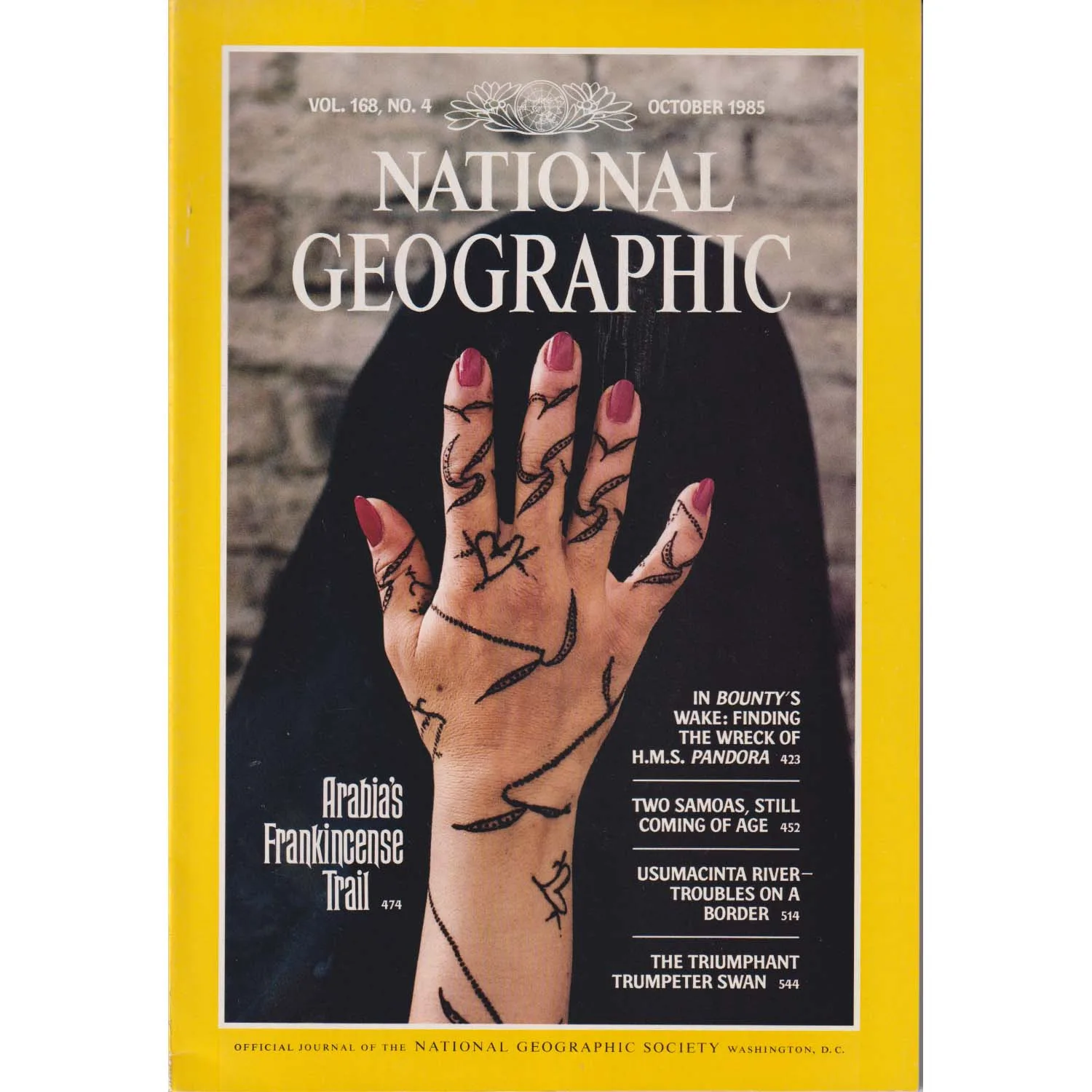
National Geographic, October 1985, arrives in its famous yellow frame looking like it’s about to do two things at once: open the world up… and gently tell you to mind your manners. The cover is unforgettable—an intricately patterned hand held up, palm-out, nails neatly painted, against a dark veil. It’s part greeting, part boundary, part “yes, you may observe, but you will not simplify.” In other words: peak National Geographic, when curiosity came with a dress code.
The headline “Arabia’s Frankincense Trail” sounds quaint now, like a candle you buy because you’ve decided your life needs more “calm.” But this issue reminds you that frankincense was once serious business: a resin so prized it crossed deserts and empires, perfumed temples, funded trade routes, and turned camels into the original logistics network. Nat Geo does what it does best—turning an everyday word into a whole civilisation of heat, hardship, bargaining, ritual, and landscape. Expect desert light, ancient pathways, and the kind of careful, patient writing that makes you feel like you’ve been quietly upgraded as a person.
And then—because 1985 Nat Geo never travelled light—the rest of the issue is a gloriously eclectic world tour that refuses to stay in one mood. You get “In Bounty’s Wake: Finding the Wreck of H.M.S. Pandora” (shipwreck archaeology with a side of mutiny aftertaste—history, but soggier), “Two Samoas, Still Coming of Age” (islands navigating identity, modernity, and other people’s expectations), “Usumacinta River—Troubles on a Border” (a reminder that rivers do not care about lines on maps, but governments very much do), and “The Triumphant Trumpeter Swan”—a rare Nat Geo genre: the environmental story that lets you exhale at the end.
The irony of this issue is delicious. It’s about trade routes, borders, and wrecks—human attempts to control movement and meaning—yet the most powerful image is simply a hand saying “stop,” framed by silence and dignity. It’s also a magazine about the exotic “elsewhere,” sold to people sitting on sofas in 1985, while quietly hinting that the real work of understanding is slower, more respectful, and far less glamorous than the word “adventure” suggests.
Condition: Good, which is exactly what you want from a 40-year-old portal to the world: intact, readable, ready to be opened on a table like a ritual. Sold by Crappy Old Books, which is the perfect punchline—because this isn’t just “old.” It’s a glossy, incense-scented, shipwreck-haunted, swan-saving artefact of an era when global wonder arrived monthly, in paper form, and you could literally hold it in one hand (politely raised, of course).
Keep browsing: See more National Geographic books Other books by National Geographic
